By Mary Beth King
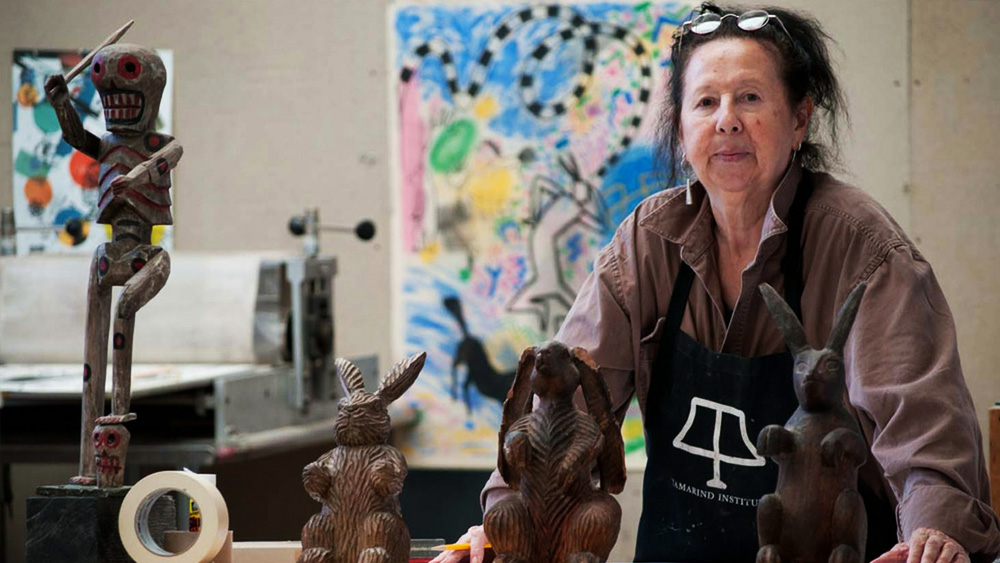
As a Native American, she might have been expected to follow in the traditional ways of weaving rugs, making baskets, or creating pottery. But Quick-to-See Smith has forged her own path and at the age of 83, she’s busier than ever as an activist and leader working, in her own words, “to break the buckskin ceiling.”
Quick-to-See Smith has recently accomplished some firsts for a Native American artist.
This past spring and summer, the first retrospective of a Native American artist was shown at the Whitney Museum of American Art in New York City. Jaune Quick-to-See Smith: Memory Map brought together nearly five decades of Smith’s drawings, prints, paintings, and sculptures in the largest and most comprehensive showing of her career to date. The exhibition is now at the Modern Art Museum of Fort Worth through January before heading to Seattle.
CBS News covered Quick-to-See Smith’s Whitney exhibition, noting, “It’s a milestone moment for the 83-year-old artist but also for the Whitney. This is its first retrospective for a Native American artist.”
She also curated an exhibition at The National Gallery in Washington, D.C., entitled The Land Carries Our Ancestors, the first Native American to curate a show there. The Washington Post called it “a belated corrective for Native American art” and noted that it wasn’t until 2020 that the gallery made its first acquisition of a painting by a Native American artist, a 1992 mixed media work by Quick-to-See Smith called Target. Among the pieces in the exhibition are works by UNM alumni Raven Chacon (Diné), a composer and artist who last year became the first Native American to win a Pulitzer Prize in music, and Tamarind printmakers Emmi Whitehorse, Dyani White Hawk, Jeffery Gibson, and Marie Watt.
A range of programs and events accompanies the exhibition. A related book published by the National Gallery in association with Princeton University Press features a poem by 23rd U.S. Poet Laureate and Joy Harjo (Muscogee [Creek] Nation), 23rd US poet laureate and UNM alumna, and an essay by Quick-to-See Smith.
The Corrales artist also received the Smithsonian Institution’s Archives of American Art Medal for her work as an artist, educator, and activist in August in New York.
I may be the longest working artist at Tamarind. It’s been a blessing in my life. Created a printmaking career, no question.
–Jaune Quick-to-See Smith
Told at an early age that “Indians don’t go to college,” Quick-to-See Smith didn’t get a degree in art until she was in her 40s. She moved to Albuquerque in 1976 in pursuit of a degree in Native American studies at The University of New Mexico.
“There was a large Native American Studies department [at UNM] which was encouragement to attend school here rather than the University of Colorado, Boulder or University of Montana, Missoula, two other schools that I looked at for grad school. Geary Hobson was the director of UNM’s department and was a wonderful teacher. He worked so hard and delivered incredible information on Native literature. I took many courses from him. That’s a teacher who lasts a student’s lifetime,” Quick-to-See Smith said.
But after being turned down for the Native American studies program, she turned to the arts and so began her long association with UNM., graduating with a master’s degree in art in 1980. Quick-to-See Smith was awarded an honorary doctorate by UNM in 2008.
“At UNM, there were very few Natives in the Art Department, but Emmi Whitehorse was my first friend when I came to school here. We took classes together. We are still friends.”
Quick-to-See Smith also began her association with the Tamarind Institute with its extensive lithography program.
“[Former Tamarind director] Marge Devon saw my work in a student show at UNM and invited me to come to Tamarind and make a print. Bless her! I always give her credit for starting my printmaking career. I had not taken printmaking classes at UNM… I may be the longest-working artist at Tamarind. It’s been a blessing in my life. Created a printmaking career, no question. I owe it to Marge Devon,” Quick-to-See Smith recalled.
She now lives in Corrales, a rural village just outside of Albuquerque, where she maintains an art studio with her son Neal Ambrose-Smith, also a UNM alum.
“My son Neal, the painter and multi-media artist, who attended UNM for his graduate degree 25 years after I graduated, took multiple courses from Aaron Frye and Lydia Madrid, Aaron in Native Studies and Lydia in printmaking. He still talks about what great teachers they were and how much he learned from them. Those are teachers who last a student’s lifetime,” she said.